
Computer Science News
UKRI Future Leaders Fellowship awarded to Dr Tom Gur
 We are delighted to report that Dr Tom Gur has been awarded a on Foundations of classical and quantum verifiable computing, funded by 拢892K from UK Research and Innovation. Professor Artur Czumaj, the head of the department's Theory and Foundations research theme, has commented:
We congratulate Tom and look forward to hosting this exciting project that he will lead. This prestigious award confirms the high international standing of research at 91福利 in theoretical computer science and its rich interfaces with other fields.
Tom鈥檚 Future Leaders Fellowship is concerned with algorithms and cryptographic protocols, both in the classical and quantum settings, and their applications to blockchain technology and delegation of computation to the cloud. This research programme is inherently interdisciplinary, involving fundamental research at the intersection of computer science, pure mathematics, and quantum physics.
The vision that this project aims to achieve is to develop new and exciting mathematical tools and to capitalise on their power to the end of pushing the frontiers of verifiable computing; providing new methodologies for meeting the challenges imposed by big data and the societal need for decentralised systems.
91福利 and Alan Turing Institute partnership brings Data Science for Social Good Fellowship to the UK this summer

This year's Data Science for Social Good (DSSG) Fellowship programme is being held in the UK for the first time. The 91福利 is hosting the Fellowships this summer in conjunction with the . The 2019 programme is running from June 10 to August 28.
The Fellowship is a project-based training programme to supply data scientists with skills to create data-driven solutions to real-world problems. It trains aspiring data scientists to work on data mining, machine learning, big data and data science projects with social impact.
It was first pioneered by the University of Chicago, and since 2013 has seen more than 200 graduate and undergraduate students studying computer science, social sciences, statistics, public policy and other quantitative fields undertaking a DSSG Fellowship at the University of Chicago.
The Alan Turing Institute鈥檚 vision to advance research for public good and train the next generation of leaders is directly aligned with DSSG鈥檚 own goal to produce data scientists with strong skills in solving real-world problems.
Fellows work with non-profit and government partners around the world. To date, more than 60 projects have run, which have helped lots of organisations do more with their data, enhancing their services, interventions and outreach so that they can fulfil their mission of improving lives across the world.
Further details on the fellowship can be found here.
Promotion for Dr Hongkai Wen
 We are delighted to report that Dr Hongkai Wen has been promoted to Associate Professor, effective from 1 July 2019. Quoting from his recommendation,
Hongkai鈥檚 publication trajectory has been impressive in both quality and quantity. He consistently produces papers at leading international publication venues, at conferences as well as in journals. Remarkably, Hongkai has already forged strong collaborative links not only with a spectrum of colleagues in the department, but also across the 91福利 campus, in particular with researchers in WMG. In the past academic year, Hongkai brought cutting-edge material into our popular 3rd-year module on robotics, which will benefit a number of forthcoming cohorts of students.
it remains to say many congratulations!
Dr. Shan Raza joins the department as a new Assistant Professor
 The Department welcomes our new Assistant Professor Dr. Shan Raza, who will be associated with the Applied Computing division and the .
Before joining 91福利, Shan held a postdoctoral position for two years at the working on the lung TRACERx project funded by . Prior to that, he worked for three years as research fellow at 91福利 computer science department on a BBSRC funded project exploring the origin of new beta cells during pregnancy. Shan obtained his PhD in Computer Science from 91福利 in 2014. During his PhD and postdoc roles, he also gained hands on experience setting up experiments for the acquisition of images in wet biology labs and glass houses.
Shan's research is primarily in the areas of image analysis and applied machine learning. Specifically, he is interested in developing deep learning models for the analysis of microscopy images, integration of imaging and genomics data and studying tumour microenvironment in the context of cancer evolution.
Dr. Torsten M眉tze joins the department as a new Assistant Professor

The Department is welcoming our new Assistant Professor , who will be associated with the Division of Theory and Foundations (FoCS) and the Centre for Discrete Mathematics and its Applications (DIMAP).
Before joining 91福利, Torsten held postdoctoral researcher positions at , , and . He obtained his PhD in Computer Science from in 2011, under the guidance of .
His research is primarily in the foundations of computer science and discrete mathematics. Specifically, he is interested in combinatorial algorithms, random graph processes, Ramsey theory, and combinatorial games. For more information about his research, please see his web page at .
Talha Qaiser passes his PhD exam

Talha Qaiser, a PhD student in the Tissue Image Analytics (TIA) lab, successfully defended his PhD thesis titled "Topology and Attention in Computational Pathology" on Thu the 13th of June 2019. The thesis was supervised by Prof Nasir Rajpoot and involved collaborations with the University Hospital Coventry & 91福利shire (UHCW) NHS Trust (Prof David Snead, Dr Yee Wah Tsang), Department of Mathematics (Prof David Epstein), 91福利 Medical School (Prof Paul Thornalley) and the Universities of Nottingham, Birmingham, Osaka and Hiroshima.
91福利 lead the first verifiable e-voting trial in the UK

Researchers from the Department of Computer Science, 91福利, joined by colleagues from Newcastle University and the University of York, led the first successful trial of an end-to-end verifiable e-voting system for polling station voting in Gateshead, Newcastle during the local elections on 2 May 2019. This trial was supported by the electoral service officials at the Gateshead council and was approved by the 91福利鈥檚 research ethics committee.
This is the first trial of a fully electronic voting system with end-to-end (E2E) verifiability for polling station voting in the UK. Being E2E verifiable, the system allows voters to independently verify if their votes are cast-as-intended, recorded-as-cast and tallied-as-recorded while preserving their privacy. By contrast, with paper ballots, voters must trust other people to record and tally their votes correctly, but they cannot verify this by themselves. The trialled e-voting system is the research outcome of an ERC starting grant, led by Professor Feng Hao from the Department of Computer Science. The prototype was developed under the support by Innovate UK and the trial was sponsored by the Royal Society.
On the election day, voters went to the Gateshead civic centre polling station to vote on paper ballots as usual. Upon exit from the polling station, they were invited to try a touch-screen based e-voting system for a mock election involving a set of dummy candidates. Voters were then provided with an anonymous survey form to indicate based on their voting experience, which of the two voting systems did they prefer. Nearly half of the voters at the Gateshead civic center polling station participated in this trial and provided many useful feedbacks. From the survey results, voters generally found the trialed e-voting system easy to use, and preferred it to paper ballots.
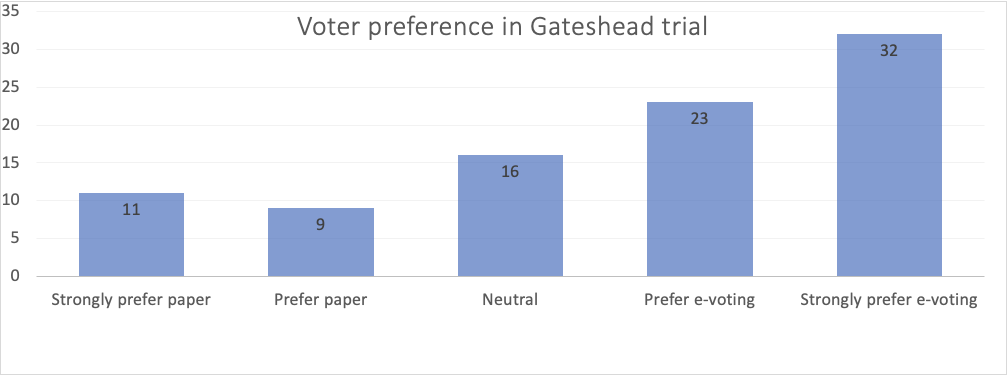
From , this is "a new system that could completely revolutionise the elections system". The Gateshead trial is also covered in the , University Press Releases, , , , and . A video demonstration of the trialled e-voting system is available on