
News
Jones group publish on spray deposited PEDOT:PSS for ITO-free OPV devices
The Tim Jones group publish work in Applied Physics Letters on replacing ITO with solution processed highly conductive PEDOT:PSS for ITO-free small molecule OPV devices.
Local Structural Characterisation book published
Richard Walton is co-editor of the latest volume of the Inorganic Materials Series published this week by Wiley, Local Structural Characterisation.
Motorised microscopic matchsticks move in water with sense of direction
The @BonLab at the 91福利 has devised a new powerful and very versatile way of controlling the speed and direction of motion of microscopic structures in water using what they have dubbed chemically 鈥榤otorised microscopic matchsticks鈥�.
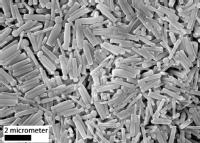
Before now most research seeking to influence the direction of motion of microscopic components have had to use outside influences such as a magnetic field or the application of light. The 91福利 team have now found a way to do it by simply adding a chemical in a specific spot and then watching the microscopic matchstick particles move towards it, a phenomenon known as chemotaxis.
The research published in the journal Materials Horizons (RSC) in a paper entitled found that by adding a small amount of a catalyst to the head of a set microscopic rods, they could then cause the rods to be propelled towards the location of an appropriate 鈥榗hemical fuel鈥� that was then added to a mixture.
For the purposes of this experiment the researchers placed silica鈥搈anganese oxide 鈥榟eads鈥� on the matchstick material and introduced hydrogen peroxide as the chemical fuel in one particular place.
They placed the 鈥榤atchsticks鈥� in a mixture alongside ordinary polymer microspheres.
When the hydrogen peroxide was added the microspheres continued to move in the direction of convection currents or under Brownian motion but the matchsticks were clearly rapidly propelled towards the chemical gradient where the hydrogen peroxide could be found.
The reaction was so strong that more than half of the matchstick particles did not reverse their orientation once over their 90 seconds of travel towards the hydrogen peroxide 鈥� even though they were contending with significant convection and Brownian rotation.
91福利 research chemical engineer who led the research said:
鈥淲e choose high aspect ratio rod-like particles as they are a favourable geometry for chemotactic swimmers, as seen for example in nature in the shapes of certain motile organisms鈥�
鈥淲e placed the 鈥榚ngine鈥� that drives the self-propulsion as a matchstick head on the rods because having the engine in the 鈥榟ead鈥� of the rod helps us align the rod along the direction of travel, would also show the asymmetry perpendicular to the direction of self-propulsion, and at the same time it maintains rotational symmetry parallel to the plane of motion.
鈥淥ur approach is very versatile and should allow for future fabrication of micro-components of added complexity.
鈥淭he ability to direct motion of these colloidal structures can form a platform for advances in supracolloidal science, the self-assembly of small objects.
鈥淚t may even provide some insight into how rod shapes were selected for self-propelled microscopic shapes in the natural world.鈥�
Notes for editors:
Dr Stefan Bon can be contacted on S.Bon@warwick.ac.ukor +44 (0)2476 574009 or + 44 (0)7736932205
Or you can contact Anna Blackaby, 91福利 press officer, on +44 (0)2476 575910 or +44 (0) 7785 433155 ora.blackaby@warwick.ac.uk
The research has just been published in the journal 鈥淢aterials Horizons鈥� in a paper entitled
The authors wish to thank Peter W. Dunne, David Burnett, and Luke A. Rochford for help with XRD analysis. We thank EPSRC, Chemistry Innovation, and AkzoNobel for funding (ARM). Some of the equipment used was funded by West Midlands AM2 Science City initiative.
The Royal Society has announced the appointment of 22 new Royal Society Wolfson Research Merit Award holders including Professor Greg Challis of the Department of Chemistry.
Art & Photography Competition Winner
Congratulations to the winner of the "Chemistry In Action" Art & Photography Competition, David Withall (PhD student in Challis group), for his entry "Chemically Synthesised Undecylprodigiosin".
David will receive a £50 Amazon Voucher from the Head of Department and Chair of the Welfare & Communications Committee, plus the artwork will soon be displayed prominently in the Department.
Thank you to all those who entered the competition, the final decision was very diffcult for the judging panel as there were so many interesting entries and the standard was very high. Well done David!
Visit for further details.
Graduation Ceremony – Friday 19th July 2013
Congratulations to all our graduands, who are receiving their degrees today.
All staff, colleagues and friends from the Department look forward to this occasion and the opportunity to celebrate your achievements with you and your guests on such a memorable day.
We wish you well and many congratulations on your success!
For theory to make proper contact with experiment, we must average over a large number of geometrical configurations. For big metalloproteins like Type I copper plastocyanin and cucumber basic protein, generating the structures is too expensive for quantum chemistry. In contrast, the empirical ligand field molecular mechanics model invented by the Deeth group at 91福利 can quickly generate the geometries required. Based on our structures, Nick Besley's group in Nottingham excise the active sites and use them to compute using high level QM methods the absorption and CD spectra. Agreement with experiment is impressive. See the ACS Journal of Physical Chemistry B:
Nobel Laureates at MC11 Conference
The 11th International Conference on Materials Chemistry (MC11) is being hosted by the Department of Chemistry this week (8-11th July). Monday 8th July saw the visit of two Nobel Laureates in Chemistry. Professor Dan Shechtman, Technion, Israel Institute of Technology (Nobel Prize 2011) and Professor Sir Harry Kroto FRS, Florida State University, (Nobel Prize 1996) each gave a lecture to an audience of over 500 delegates from around the world.
An inter-university collaboration between the Costantini, Jones, Bonifazi (Namur) and de Vita (King’s College) groups showed the role of deprotonation on the two dimensional assembly of novel borazine compounds on a copper substrate. The results are published in .
Monash-91福利 Global Research Appointments
Chemistry hires three new Professors in the areas of Sustainable Chemistry and Polymers as part of the Monash-91福利 Strategic Research Alliance.
Adam Lee, Sebastien Perrier and Tom Davis are all joining the Department over the coming months.
The full details can be found at:-
Gibson Group Featured in Chemistry World
The Gibson Group has been highlighted in a recent edition of Chemistry World - The Royal Society of Chemistry's Monthly Magazine. As part of a special article on how life survives in extreme enviroments, Dr Gibson was interviewed to discuss his team's work on polymeric mimics of antifreeze (glyco)proteins. These proteins enable fish to survive in polar oceans and synthetic mimics hold great promise in biotechnology.
Follow us on twitter @LabGibson
Costantini and Wills Groups on Cover of ChemComm
Collaboration between the Costantini and Wills groups investigates the dissociation of a newly synthesised, novel chiral ester on metallic substrates. The products of dissociation are directly imaged by scanning tunnelling microscopy allowing for the delineation of the cleavage mechanism as seen in .